Beyond Google Maps: Tackling Complex Route Variables in Wholesale Bakery Logistics
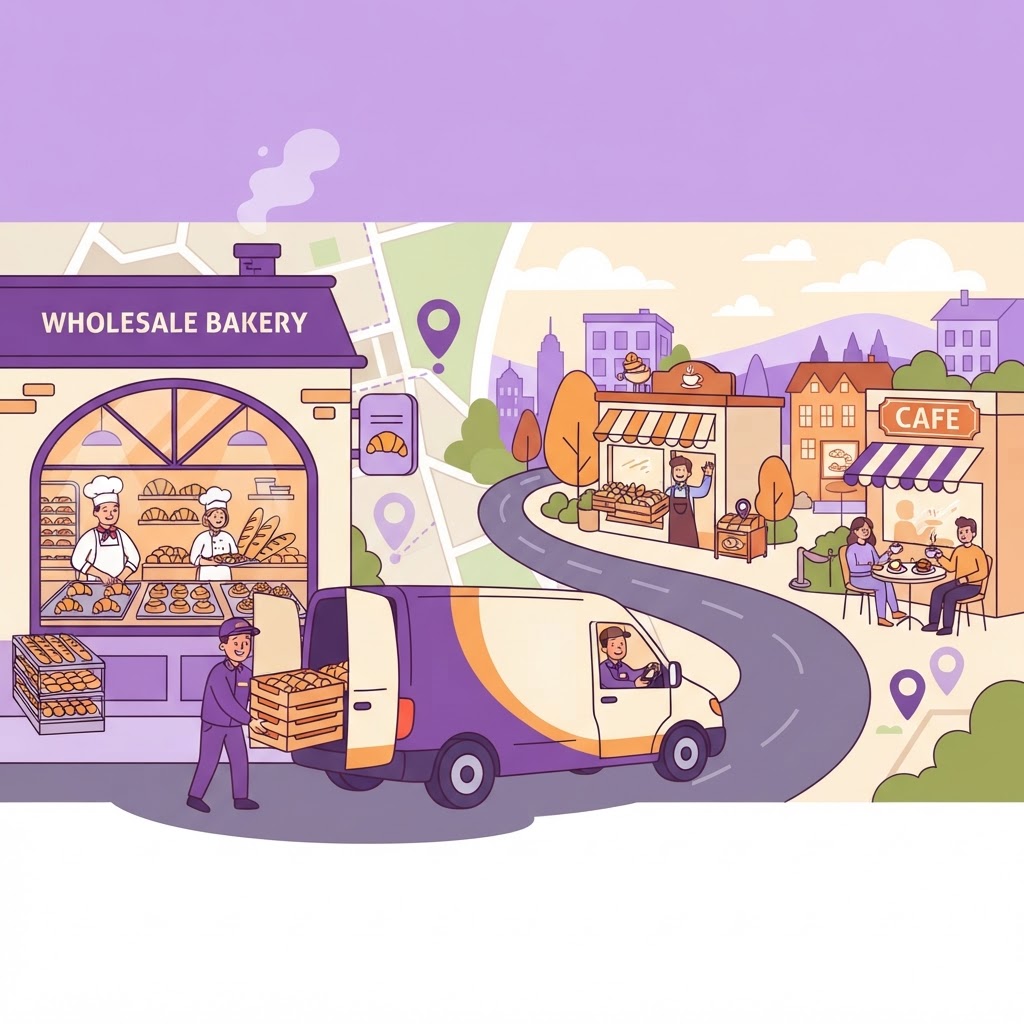
For most wholesale bakeries, the delivery fleet is a hidden profit center—or a massive drain on resources. While consumer mapping apps are excellent for point-to-point navigation, they fail to grasp the high-stakes, time-sensitive nature of dawn bakery runs. Mastering the 'Vehicle Routing Problem' (VRP) isn't just about saving fuel; it is about ensuring that the croissants reach the cafe before the morning rush, all while keeping your operational costs lean.
The
Complexity of the Bakery Delivery Window Unlike standard courier services, wholesale bakery deliveries are constrained by extremely tight 'time windows.' Cafes expect fresh products before their doors open, typically between 5 AM and 7 AM. If a van arrives too late, the customer suffers; if it arrives too early, the staff may not be on-site to receive the delivery.
This creates a 'frozen' timeline where your fleet must service multiple stops in a narrow, two-hour peak period. Standard routing tools assume a static environment, but your bakery faces constant flux, including traffic patterns that evolve daily and delivery zones that shift based on seasonal cafe demand. Treating every route as a static path is a recipe for inefficiency.
Accounting for
Vehicle and Load Constraints Another layer of the VRP involves the physical limitations of your fleet. Not every van is identical, and not every delivery requires the same amount of space. Intelligent routing must account for:
-
Payload capacity: Ensuring weight distribution doesn't violate safety regulations.
-
Refrigeration zones: Prioritizing temperature-sensitive goods if your vans are split-climate.
-
Tray volume: Calculating total stack height so that the final delivery of the route is actually accessible without offloading half the van.
When these factors are ignored, drivers end up 'shuffling' cargo at every stop. This adds minutes to every delivery, and over a 20-stop route, that inefficiency compounds into an hour of lost time, idle engine run-time, and driver exhaustion.
The
Impact of Stop Density on Profitability Stop density is the measurement of how many customers you serve within a specific geographic cluster. A common mistake is allowing 'route creep,' where drivers travel long distances between two sparse points. If your route density is low, you are essentially paying your drivers to drive empty air.
Modern route optimization shifts the focus from 'shortest distance' to 'highest density.' By intelligently grouping deliveries by proximity, you decrease the time between stops. This shift allows you to increase the number of orders per vehicle without requiring additional drivers, significantly lowering your cost-per-delivery.
Incorporating
Dynamic Traffic and Road Patterns Traditional routing breaks down when confronted with the reality of morning traffic. Construction, school zones, and localized accidents create bottlenecks that manual scheduling simply cannot predict. A robust VRP strategy incorporates real-time data feeds to adjust routes while the fleet is already in motion.
Automated systems can re-sequence stops on the fly based on current road conditions. By rerouting a driver around a major delay, you maintain your 'freshness promise' to the cafes. This level of adaptability is what separates a modern, tech-enabled bakery from one that relies on a binder of static maps and driver intuition.
The
Human Element: Driver Satisfaction Finally, we must consider the driver. Routes that are poorly designed lead to high turnover, as drivers become frustrated with chaotic schedules and unnecessary backtracking. Providing drivers with clear, optimized, and logical routes not only reduces mental fatigue but also improves the consistency of your service.
When the system suggests a logical flow, the driver feels empowered rather than stressed. A well-planned route reduces the likelihood of missed drops, damaged goods, or incorrectly filled orders, all of which ultimately improve your relationships with the cafes you supply.
Practical
Takeaways for Fleet Managers
- Audit your current delivery window: Identify if your routes are actually achievable in the time allotted or if your drivers are constantly racing against the clock.
- Focus on density: Map your current customer base and re-cluster stops based on geographic proximity rather than historical 'this is how we've always done it' habits.
- Evaluate your tech: If you are still using manual mapping or paper logs, you are losing money on fuel and labor every single day.
By treating your delivery network as a mathematical problem to be solved rather than a chore to be completed, you can turn your bakery fleet into a high-performance engine for growth.