Maximizing Tray Density: Reducing Fleet Overhead Through Intelligent Packing
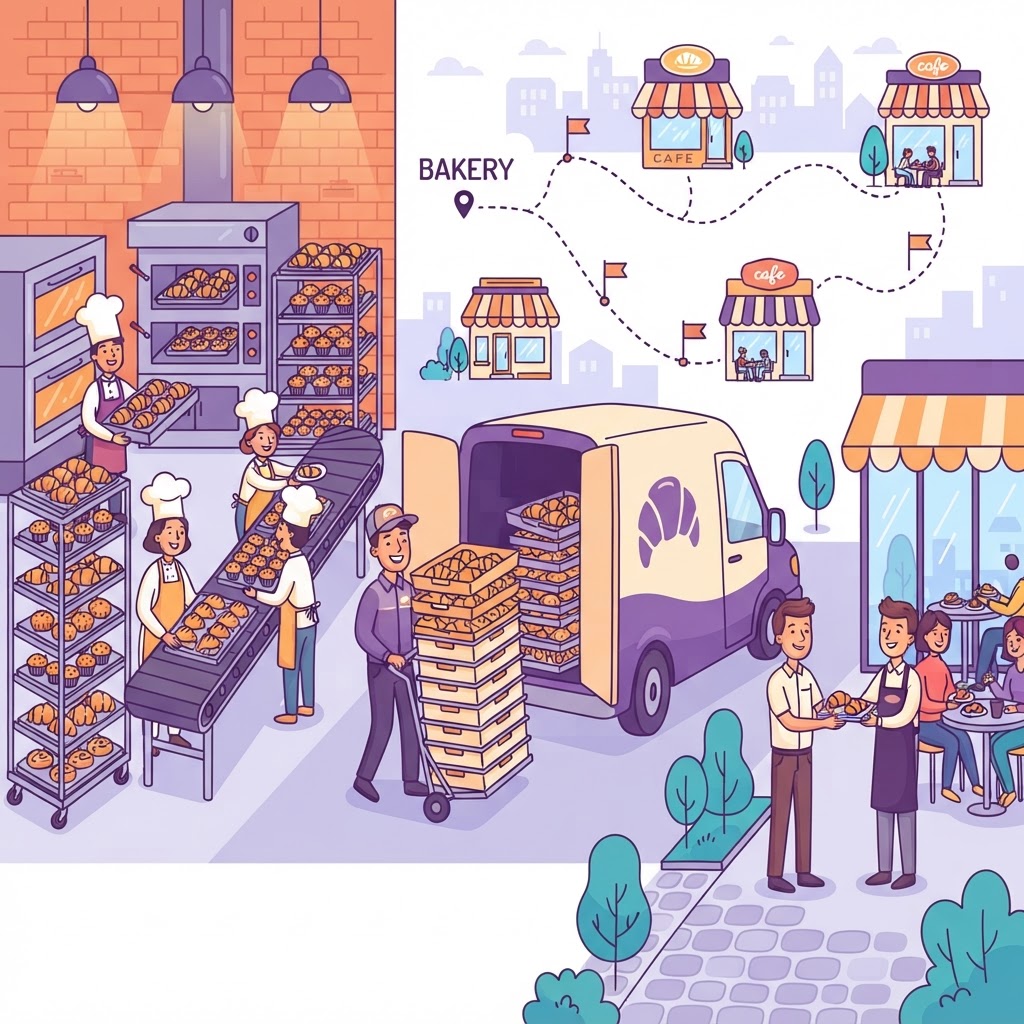
In the high-stakes world of wholesale baking, your delivery fleet is often the single most significant variable cost. While fuel prices fluctuate and vehicle maintenance adds up, the most overlooked driver of expense is the physical space utilization within your transport trucks. If your delivery drivers are heading out with half-empty racking systems, you are essentially paying to transport air across your service area.
By shifting your focus toward maximizing tray capacity and spatial density, you can fundamentally re-engineer your logistics model to cut fuel costs and reduce wear and tear on your vehicles.
The
Geometry of Your Pastry Logistics
Many wholesale bakeries treat delivery as a process of simple loading, where orders are slotted into trays without regard for the cubic efficiency of the vehicle. However, when you treat your delivery fleet as a three-dimensional puzzle, the math shifts in your favor. Achieving a higher 'tray-to-mile' ratio means that each liter of fuel is working harder by delivering a higher volume of product.
To improve your density, start by auditing your current rack configurations. Are you using standardized tray footprints that accommodate the specific dimensions of your various pastry boxes, or are you utilizing inefficient, irregular sizing that leaves dead space at the edges? Standardizing your inventory packaging is the first step toward perfect vertical stacking and seamless rack integration.
Balancing
Weight and Volume Constraints
While volume is a major concern, weight remains a limiting factor that dictates your maximum truck capacity. Heavy, dense sourdough loaves and light, airy croissants require different stacking strategies to ensure both structural integrity and weight distribution. By grouping orders based on density profiles, you can optimize the load so that your trucks remain stable while carrying the maximum possible quantity.
Consider utilizing smart loading software that accounts for the weight limits of your specific refrigerated vehicles. When your loading team knows exactly how many high-density items can be safely placed at the bottom of a stack versus more fragile items at the top, you reduce damage and increase the total tray count per trip. This leads to a higher utilization rate of your existing fleet, allowing you to cover the same number of stops with fewer trucks on the road.
Consolidating
Routes for Maximum Utilization
Optimizing your packing is only half the battle; the other half is route synchronization. When you pack your trucks at near-maximum capacity, you gain the flexibility to consolidate smaller, adjacent delivery zones into single runs. This prevents the scenario where two half-filled trucks are covering the same suburban neighborhoods on the same morning.
- Analyze your historical volume patterns for each delivery zone.
- Implement 'cluster-packing' where trays for neighboring cafes are loaded in sequence.
- Use dynamic route planning to ensure that the truck's volume capacity is utilized at the start of the journey, gradually thinning out as the truck makes its drops.
The
Cost of Underutilization
It is easy to underestimate the cost of a delivery run that is only at 60% capacity. Beyond the obvious fuel waste, you are also bearing the cost of driver wages, vehicle insurance, and depreciation for that same time spent on the road. By ensuring that every truck leaves the dock at 90-95% capacity, you directly contribute to your bottom line, essentially making more profit per kilometer driven.
If you find that your current order volume requires an extra vehicle, look at the consolidation potential first. Often, a few minor adjustments to your delivery windows or a more rigid approach to stop-clustering can eliminate the need for that additional vehicle entirely. The goal is to maximize the throughput of your existing hardware, which is the most effective way to protect your margins.
Strategic
Takeaways
To achieve true efficiency, start by auditing your packaging dimensions to ensure uniform tray fitting. Prioritize packing based on a mixture of volume and structural weight to optimize every cubic centimeter of your racking system. Finally, align your route scheduling with your maximized load capacity to minimize the total number of vehicles leaving the bakery each morning.
By treating tray space as a valuable asset, you move away from reactive delivery management and toward a proactive, cost-efficient logistics strategy.